

ADV 1.5T All Directional VNA AMR— In-Depth Technical Analysis and Application Selection Guide
In the 7–11 meter warehouse height segment, narrow-aisle unmanned forklifts are rapidly becoming the preferred solution for an increasing number of enterprises. However, "narrow aisle" is merely a blanket term — the chassis architecture, navigation methods, safety ratings, fleet dispatching capabilities, and application adaptability differ dramatically across different technical approaches. This article uses the FOBOT ADV 1.5T as a technical case study, dissecting it across seven core dimensions — chassis, navigation, safety, controller, vehicle body, fleet dispatch, and lifting — while providing professional parameter comparisons with Reach AGVs and VNA Forklifts, ultimately delivering evidence-based selection guidance for the 7–11m scenario.
1. An Underappreciated Critical Height Segment: 7–11 Meters
In warehouse automation planning, most decision-makers focus on two extremes — either pursuing "fully automated high-density AS/RS systems" or remaining at "ground-level AGV transport." Yet 7–11 meters represents precisely the golden height range for optimal warehousing ROI:
· Above 12 meters: Racking structural costs, equipment precision requirements, and safety compliance costs escalate sharply;
· Below 5 meters: Ground-level solutions are simpler but storage density is constrained, resulting in insufficient land utilization;
· 7–11 meters: Racking investment and storage output reach optimal balance, offering the widest equipment selection flexibility and shortest ROI payback period extremes
However, this height segment is also the most complex for equipment selection:
Solution | Key Pain Points |
Reach AGV | Aisle width ≥3.2 m; limited storage density; efficiency declines at height |
VNA Forklift (Three-way) | Low throughput; efficiency declines at height; high initial cost |
Four-way Shuttle System | High initial investment; strong system rigidity; capacity expansion requires full-system retrofit |
Manual + Forklift | Continuously rising labor costs; significant safety hazards in high-level operations |
What this height segment truly demands is a solution that simultaneously delivers narrow-aisle pass-through capability, omni-directional flexibility, high-level stability, and multi-vehicle coordination.
The FOBOT ADV 1.5T (All Directional VNA AMR) was engineered precisely for this purpose.
The ADV chassis employs a dual steer-drive omni-directional drive structure — two independent steer drive wheel units, each simultaneously controlling steering and propulsion. This is not the "differential steering" or "Ackermann steering" found on conventional AGVs; it is true full-degree-of-freedom motion:
· Straight travel (forward/reverse): Full-load speed 1.5 m/s, unloaded 1.8 m/s
· Lateral shift (left/right): No turning required — direct lateral entry/exit from rack positions
· Diagonal travel: Movement at any oblique angle without multi-step turning adjustments
· In-place 360° rotation: Complete directional change within a 3.8 m aisle
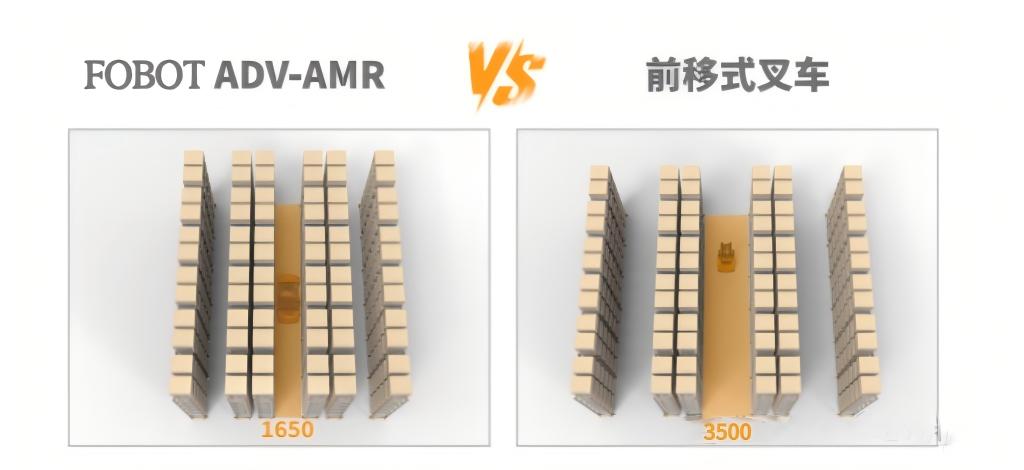
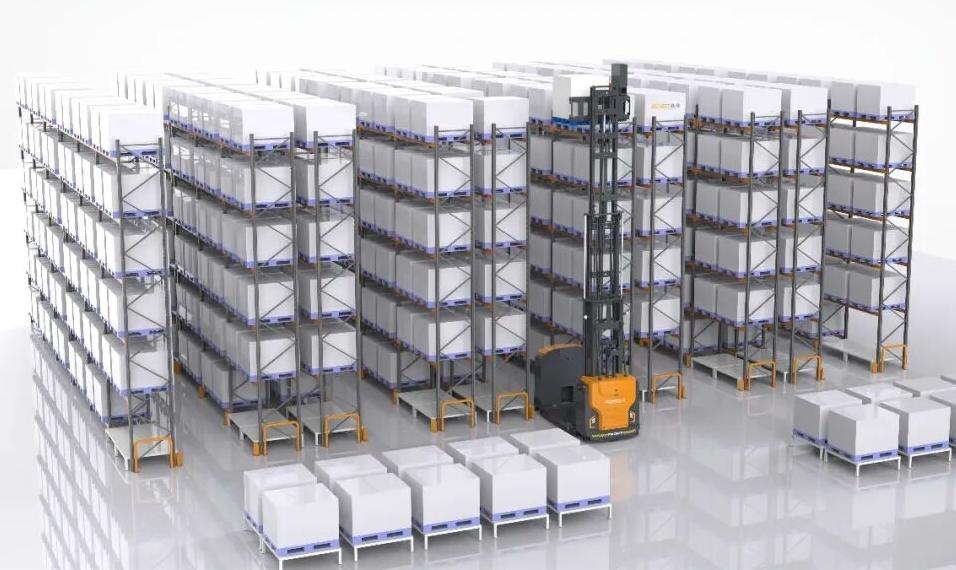
Core Advantage: With a vehicle width of 1,580 mm, the right-angle stacking aisle width (Ast) is only 1,650 mm (including pallet). Compared to the 2,700–3,200 mm aisle requirement of conventional reach-type vehicles, aisle area is reduced by 30–40% — enabling 1–2 additional rack rows in the same warehouse footprint and a 15–25% increase in storage density.
In the 7–11 meter high-level environment, each additional rack row translates to thousands of extra pallet positions, directly transforming the investment return model.
The ADV employs a hybrid navigation architecture combining laser reflectors, 3D SLAM, and magnetic tape / rail guide, forming a three-tier fused positioning system:
Tier | Technology | Function |
Tier 1 | 3D Laser SLAM | Real-time 3D point cloud mapping, global path planning, and dynamic obstacle avoidance |
Tier 2 | Magnetic tape or mechanical rail guide | High-precision aisle guidance within rack corridors; eliminates SLAM drift |
The switching logic between the three navigation tiers is adaptive: in open areas, SLAM takes priority for free path planning; upon entering narrow aisles, magnetic tape takes over to ensure linear precision, with mechanical rail providing the ultimate positioning fallback.
Positioning Accuracy: Navigation accuracy ±10 mm, stopping accuracy ±10 mm. Under 7–11 meter high-level conditions, the fork-to-rack docking deviation is controlled at the millimeter level, preventing collisions with racking or cargo.
Safety is the non-negotiable baseline for high-level warehousing. The ADV premium versions (ADV15-S / ADV15-CE) are designed to CE standards at Performance Level D (PL-D) functional safety, with a full dual-circuit redundancy architecture for all inputs and outputs — every safety signal has independent input and output channels. Upon primary circuit failure, the backup circuit takes over within milliseconds and triggers a safe stop.
Complete safety protection matrix:
Protection Layer | Configuration | Function |
L1 — Ground-level protection | Bottom 2D laser obstacle avoidance radar | 360° full-coverage; redundant zone design eliminates failure risk |
L2 — 3D spatial | 3D obstacle avoidance LiDAR (high-performance version) | Covers 3D space ahead of travel path; detects overhead obstacles |
L3 — Cargo detection | 2D over-protrusion detection | Detects cargo protruding beyond vehicle body; simultaneously detects forward obstacles |
L4 — Mechanical fallback | Mechanical contact bumper | Physical contact triggers emergency stop; final safety fallback |
L5 — Mast interlock | High/mid/low mast position detection | Hardware-level interlock; directly limits travel speed based on mast height |
L6 — Unloading safety | Unloading space detection | Ensures no cargo/personnel in the pick-up/drop-off zone |
L7 — Pallet recognition | Multi-mode pallet identification | Precision pick-up + drop-off position detection; supports multiple pallet types |
L8 — Fork-tip avoidance | Photoelectric detection at fork tip | Ensures safety ahead of telescopic forks |
L9 — Load management | Overweight/overload/load detection | Includes overload curve detection, pick-up load detection, and drop-off detachment detection |
Key Design Principle: All safety functions are hardware-interlocked — automatic speed limitation at height, automatic activation of fork-tip avoidance when forks extend, automatic lifting prohibition when overloaded. Safety is not a "software switch" — it is a "hardware constraint."
2.4 Core Controller: Fully Proprietary — No "Black Box" Dependencies
The ADV's core controller is independently developed by FOBOT Robotics — from the low-level hardware architecture to the upper-level motion control algorithms, with zero reliance on any third-party "black box" modules.
Core value of proprietary controller:
· Deep kinematic optimization: Custom algorithms for the dual steer-drive omni-directional kinematic model; composite motion latency (lateral + straight + rotation) controlled at millisecond level;
· Multi-actuator coordination: The linkage logic of four major execution systems — chassis, mast, fork, and rotation mechanism — is unified at the main controller level, ensuring smooth and precise composite motions;
· Seamless system integration: Open interface protocols for real-time communication with WMS/WCS/MES/ERP and upper-level systems; supports industrial-grade Wi-Fi / 5G / encrypted data transmission;
· Autonomous control: Core code is independently owned with no dependency on overseas licenses; supply chain security is guaranteed; iteration and response cycles measured in days.
The ADV's vehicle body structural components and mast systems are entirely designed and manufactured in-house, with no reliance on purchased parts. This means:
· Machining precision is controllable: Every welding station and assembly tolerance is executed under FOBOT's proprietary quality control system;
· The mast is the load-bearing core: Under 7–11 meter high-level conditions, a 1.5-ton load is lifted to 7–9 meters height. The enormous bending moments and vibrations on the mast demand extreme structural rigidity. The proprietary mast uses high-strength steel and optimized cross-section design, combined with a centered center-of-gravity layout where the load centroid coincides with the vehicle centerline, significantly reducing high-level sway;
· Full traceability: Every unit's mast manufacturing records are traceable, providing a data foundation for long-term O&M and spare parts management.
2.6 Fleet Dispatch System: Multi-Vehicle Coordination — Beyond Simple "Task Assignment"
The capability of a single AMR is the baseline; the coordination efficiency of multiple AMRs is the true productivity ceiling.
The FOBOT proprietary fleet dispatch system features:
· Dynamic path planning: Real-time traffic-based optimal route calculation, supporting dozens of AMRs operating conflict-free in the same area;
· Intelligent traffic management: Hierarchical control at intersections, narrow aisle entrances, charging zones, and other critical nodes — dynamically allocating right-of-way based on priority and task urgency;
· Multi-mode collaboration: Supports relay transport, zoned operations, and tidal scheduling — automatically allocating capacity based on business peaks and valleys;
· Real-time data synchronization: Millisecond-level data sync with WMS/WCS/MES systems — inventory status, task progress, and equipment health are visible across the entire chain.
The lifting mechanism is the critical lifeline of high-level warehousing equipment. The ADV adopts a centered center-of-gravity design philosophy — the center-of-gravity projection of the three-tier structure (fork, carriage, mast) always aligns with the vehicle's geometric center.
This means:
· Even at full 1.5-ton load lifted to maximum height, overall vehicle center-of-gravity deviation approaches zero;
· No sway or instability risk from load eccentricity — a common issue with conventional side-shift designs at height;
· Uniform load distribution on the mast; within the load curve envelope, stability factor is consistent across the full height range — no "stable at low, unstable at high" performance degradation.
Lifting Parameter | Value |
Maximum lift height | 7,000 mm / 9,000 mm (model-dependent) |
Full-load lifting speed | 0.45 m/s |
Unloaded lifting speed | 0.5 m/s |
Full-load lowering speed | 0.45 m/s |
Mast configuration | Duplex / Triplex (customized to warehouse ceiling height) |
Combined with intelligent load curve management, the system automatically calculates safe lift height and speed limits based on real-time load — strict high-level speed limits at 1.5-ton full load, with higher efficiency automatically released at half-load or empty-fork conditions.
Note: To ensure objectivity, the comparison vehicles selected are mainstream products on the market. The Reach-type AGV is a leading brand's 1.6T-class reach truck AGV; the VNA forklift is a leading brand's three-way forklift. Data sources are each brand's publicly available product manuals.
Parameter | ADV 1.5T MAX | Leading Reach-type AGV (1.6T) | Leading VNA Forklift |
Rated capacity | 1,500 kg | 1,600 kg | ~1,000 kg |
Max lift height | 11,000 mm | ~8,600 mm | ~9,000 mm |
Vehicle width | 1,580 mm | 1,360 mm | ~1,600 mm |
Right-angle stacking aisle (Ast) | 1,650 mm | ~2,800–3,200 mm | ~1,800–2,000 mm |
Navigation | Laser SLAM + Magnetic tape (rail guide) | SLAM laser navigation | SLAM laser navigation |
Positioning accuracy | ±10 mm | ±5 mm | ±10 mm |
Full-load travel speed | 1.5 m/s | ~1.0 m/s | ~1.0 m/s |
Unloaded travel speed | 1.8 m/s | ~1.0 m/s | ~1.2 m/s |
Full-load lifting speed | 0.45 m/s | ~0.30 m/s | ~0.25 m/s |
Max gradient (full load) | 1% | 1% | <1% |
Fork rotation | Bidirectional 180° omni-rotation | No rotation (reach-type) | Single-direction 180° rotation |
Degrees of freedom | Omni-directional (straight + lateral + rotation + composite) | Forward/reverse + reach fork | Forward/reverse + lateral fork |
Safety rating | CE / PL-D | Basic safety | Basic safety |
Safety architecture | Full dual-circuit redundancy | Single circuit | Single circuit |
3D obstacle avoidance | ✅ (High-performance version) | ❌ | ❌ |
Mast (proprietary mfg.) | ✅ Fully proprietary | ❌ Purchased parts | ❌ Purchased parts |
Core controller | ✅ Fully proprietary | Proprietary (forklift chassis) | Proprietary (basic AGV control) |
Data sources:
• ADV parameters: FOBOT Robotics ADV product specifications
• Reach-type AGV parameters: Leading brand CQD series reach truck AGV product manual
• VNA Forklift parameters: Leading brand VDA116 three-way forklift product manual
Dimension | ADV 1.5T MAX | Reach-type AGV | VNA Forklift |
7m high-level throughput | 25–30 pallets/hr (single vehicle) | 12–15 pallets/hr (single vehicle) | 12–15 pallets/hr (single vehicle) |
11m high-level throughput | 22–25 pallets/hr (multi-vehicle coordination) | N/A (max ~9m coverage) | 10–12 pallets/hr (single vehicle) |
High-level positioning accuracy | ±10 mm (consistent across full height) | ±5 mm (limited lift height) | ±10 mm |
Aisle width | 1,650–1,900 mm | 2,800–3,200 mm | 1,800–2,000 mm |
Storage density improvement | +15–25% vs. reach-type | Baseline | Slightly better than reach-type |
Labor configuration | 1 operator monitors multiple vehicles | 1 operator monitors multiple vehicles | 1 operator per vehicle |
Annual labor savings | 4 ADVs replace 2–3 forklift drivers; est. 300K+ RMB/yr saved | 2–3 drivers retained | 2–3 drivers retained |
Motion flexibility | ★★★★★ Omni-directional | ★★ Forward/reverse + reach only | ★★★ Forward/reverse + lateral |
Scalability | Stepwise vehicle addition; linear scaling | Stepwise addition | Stepwise addition |
Cross-zone dispatch | Same fleet, free cross-zone | Requires independent system | Requires independent system |
Key Insight: Reach-type AGVs have a positioning accuracy advantage (±5 mm) below 7 meters, but in the 7–11 meter range, their lift capacity simply cannot cover the required height. VNA forklifts can reach 9 meters, but single-direction travel limits operational flexibility — lower pick/put throughput, poor efficiency in aisle transitions, and wider aisle requirements (≥4 m).
Note: Due to configuration differences across projects, absolute cost figures are not provided here. Instead, an ROI calculation framework is presented for decision-makers to substitute their own project parameters.
ROI Calculation Model:
Annual ROI = (A + B + C) / D × 100%
· A = Annual labor savings (reduced forklift drivers × total labor cost per head)
· B = Value of additional storage positions from density improvement (new pallet positions × monthly rent per position × 12)
· C = Value of throughput increase from efficiency gains (additional throughput × profit per pallet movement)
· D = Total equipment investment (vehicles × unit price + deployment cost + annual maintenance)
ROI Key Driver Comparison:
ROI Factor | ADV 1.5T MAX | Reach-type AGV | VNA Forklift |
A · Labor savings | ★★★★★ Highly automated | ★★★★ Automated | ★★ Requires onboard operator |
B · Density benefit | ★★★★★ 1.65 m ultra-narrow aisle | ★★ Large aisle footprint | ★★★★ Narrow aisle but inferior to ADV |
C · Efficiency benefit | ★★★★ High efficiency with multi-vehicle coordination | ★★★ Limited throughput | ★★ Limited single-vehicle throughput |
D · Investment threshold | ★★★★ Phased investment possible | ★★★ Higher unit price | ★★★ Higher unit price |
Conclusion: In the 7–11 meter scenario, ADV's ROI drivers stem primarily from the dual compounding effect of labor savings + density improvement, rather than simple equipment substitution alone. As labor costs continue to rise and every square meter of warehouse space commands premium value, ADV's comprehensive economic advantage amplifies over time.
Category | Parameter | ADV 1.5T MAX |
Basic | Rated capacity | 1,500 kg |
Load center distance | 600 mm | |
Vehicle weight (incl. battery) | 5,830–5,850 kg | |
Operating environment | Indoor, 5–45°C, humidity 20%–80% | |
Dimensions | Overall dimensions (L/W/H) | 3,044 / 1,580 / 3,376 mm |
Max lift height | 7,000 / 9,000 / 11,000 mm | |
Fork dimensions | 56 × 170 × 1,050 mm (customizable) | |
Fork outer width | 570 / 680 mm (customizable) | |
Right-angle stacking aisle width | 1,650–1,900 mm | |
Motion | Navigation | Laser SLAM + Magnetic tape + Rail guide hybrid |
Drive type | Dual steer-drive omni-directional drive | |
Straight speed (loaded/unloaded) | 1.5 / 1.8 m/s | |
Stopping accuracy | ±10 mm | |
Navigation accuracy | ±10 mm | |
Max gradient (loaded/unloaded) | 1% / 2% | |
Lifting speed (loaded/unloaded) | 0.45 / 0.5 m/s | |
Lowering speed (loaded/unloaded) | 0.45 / 0.5 m/s | |
Battery | Battery type | Lithium-ion |
Voltage / Capacity | 48V / 400Ah | |
Operating time | 8 hours | |
Charge/discharge cycles | 2,000 | |
Charging method | Side charging; supports auto / manual | |
Safety | Safety rating | Basic / PL-D (CE version) |
Audible/visual alarm | Standard | |
Laser obstacle avoidance | Standard (2D/3D by version) | |
Over-protrusion detection | Standard | |
Mechanical bumper | Standard | |
Mast height interlock | Standard | |
Pallet recognition | Standard | |
Fork-tip avoidance | Standard (photoelectric) | |
Overweight/overload detection | Standard | |
Composite motion safety interlock | Standard | |
Comms & Interface | Communication | Industrial Wi-Fi / 5G / Encrypted data |
Operating mode | Automatic / Manual | |
Other | Noise level | ≤70 dB |
Mast configuration | Duplex / Triplex selectable |
In dense storage solutions, many tend to position "narrow-aisle unmanned forklifts" and "four-way shuttles" in opposition. In practice, however, the two are more often complementary than substitutive.
Dimension | Four-way Shuttle | ADV Omni-directional AMR |
Optimal scenario | High-density planar storage (many positions on the same level) | High-level intensive pick/put (7–11 m vertical space utilization) |
Core capability | Planar four-directional movement; maximum planar density | Omni-directional motion + high-level lifting + flexible dispatch |
System characteristics | Strong coupling (requires dedicated elevators, racking, conveyors) | Weak coupling (independent operation; on-demand networking) |
Expansion method | Full-system retrofit; changes ripple through entire system | Simply add vehicles; linear scaling |
Recommended combined architecture:
Division of responsibilities:
· Four-way shuttle: Planar four-directional dense transport within rack levels, maximizing same-level storage density;
· ADV: Receives pallets from shuttle layers / conveyors, completes high-level pick/put, and handles cross-level, cross-zone horizontal transport;
· Elevators: Only a minimal number needed for shuttle cross-level dispatch — no longer carrying the primary pick/put load.
Dimension | Pure Four-way Shuttle | ADV + Shuttle Combined |
Number of elevators | Many (handles all pick/put) | Few (shuttle cross-level only) |
Racking retrofit cost | High (dedicated shuttle racking required) | Medium (dedicated for shuttle zones + standard racking elsewhere) |
System scalability | Full-system retrofit | Add vehicles on demand; localized optimization |
Fault impact scope | Single shuttle failure may affect entire level | Single vehicle failure does not impact overall operation |
Maintenance difficulty | High (enclosed racking areas) | Low (ADV instantly replaceable; shuttle on-demand maintenance) |
Deployment timeline | Long (full deployment) | Short (phased zone-by-zone deployment) |
Applicable scenarios | Ultra-high density, fixed SKU, large scale | Medium-to-high density, multi-SKU, flexible adjustment |
Core Value: The combined solution significantly enhances system flexibility and economic efficiency while maintaining density, by reducing the number of elevators and the investment in dedicated racking retrofitting.
The 7–11 meter range is the "optimal ROI height segment" for narrow-aisle dense storage. But different warehouse characteristics demand different equipment combinations — there is no "one-size-fits-all solution," only the "optimal match."
Scenario 1: Standard pallets + Few SKUs + High volume + Full-pallet in/out
· Recommended: Four-way shuttle + elevator system
· Applicable when: Low SKU count, high per-product batch volume, relatively fixed in/out pattern
· Rationale: Four-way shuttles offer unmatched planar dense storage for "hundreds of pallets per SKU" scenarios
· Note: Adequate investment budget required; expansion requires full-system planning
Scenario 2: Multi-SKU + Medium batch + Frequent layout changes + High-level pick/put
· Recommended: ADV Omni-directional AMR
· Applicable when: High SKU count, frequent batch changes, frequent rack layout adjustments
· Rationale: 1.65 m aisles achieve high density; omni-directional motion adapts to frequent multi-SKU switching; stepwise vehicle addition for elastic scaling
· Typical industries: Pharmaceuticals (GMP warehouses), Food & Beverage (batch management), Daily chemicals (multi-spec), Third-party logistics
Scenario 3: Automation retrofit of existing high-level racking warehouse
· Recommended: ADV Omni-directional AMR
· Applicable when: Existing warehouse has racking installed (7–11 m), needs unmanned upgrade
· Rationale: Laser navigation requires no major racking retrofit; deployment ~15 days (vs. 60+ days for AS/RS); minimal disruption to ongoing operations
· Reference: ADV project total cycle ~60 days, on-site deployment ~15 days; conventional stacker crane total cycle ~150 days, on-site construction ~60 days
Scenario 4: Ultra-high density + High-frequency in/out + Mixed storage
· Recommended: Four-way shuttle (dense zone) + ADV (docking / cross-zone dispatch)
· Applicable when: Part of the warehouse requires maximum density, another part requires flexible dispatch
· Rationale: Shuttles maximize planar storage in dense zones; ADV handles high-level and cross-zone flexible docking
· Note: Requires strong system integration capability; recommended to be planned by an experienced integrator
Decision Factor | Scenario Weight | Four-way Shuttle | ADV Omni AMR | Shuttle + ADV |
Warehouse height | — | Suitable (intra-level) | 7–11 m optimal | Full coverage |
SKU characteristics | ★★★★★ | Best for few SKUs | Best for multi-SKU | Mixed SKU |
Batch volume | ★★★★ | Best for large batches | Best for medium batches | Mixed batches |
Scalability | ★★★★★ | ★★ Full-system retrofit | ★★★★★ Linear scaling | ★★★★ Zoned scaling |
Deployment speed | ★★★★ | ★★ Long cycle | ★★★★★ 15-day on-site | ★★★ Zoned deployment |
Investment threshold | ★★★★ | ★★★ High initial | ★★★★ Phased investment | ★★★ Phased investment |
Maintenance ease | ★★★ | ★★ Enclosed areas | ★★★★★ Instant replacement | ★★★★ Modular replacement |
7. Closing Thought: Selection Is Not About "Choosing Equipment" — It Is About "Matching the Scenario"
In the 7–11 meter golden height segment for warehouse investment, there is no "best equipment" — only the solution that best matches the scenario.
Reach-type AGVs have precision advantages at lower levels, but their lift capability caps at ~9 meters — they were never designed for this height segment. VNA forklifts have historical strength in narrow aisles, but mechanical limitations are leaving them increasingly behind in the face of omni-directional flexibility. Four-way shuttles are irreplaceable for planar dense storage, but they require an entire system — not just a single vehicle.
The value of the ADV 1.5T lies not in "replacing everything," but in:
· Fitting 11 m of high-level storage into 1.8 m-wide aisles;
· Covering the functional intersection of reach-type and VNA forklifts with a single vehicle;
· Lowering the decision threshold through phased investment;
· Redefining the efficiency ceiling of narrow aisles with omni-directional mobility.
Before making your selection, answer these three questions first:
· 1. How many SKUs do you have? What are the batch characteristics?
· 2. Is your warehouse a new build or a retrofit?
· 3. What is your business growth forecast? How much elasticity do you need?
Once the answers are clear, the right solution becomes equally clear.